I almost didn’t go to lodge last Tuesday.
It had been one of those days. Work ran late, I was tired, and honestly, I knew what was on the agenda: bills to pay, committee reports, maybe a degree if we were lucky. The couch was calling. Netflix was right there. I could just skip one meeting.
But I went anyway. And you know what happened? Nothing special. We paid some bills. Discussed the fish fry. Voted on a petition. Same as always.
Except I stayed after. Talked with a Brother I usually just nod at. Found out he’s dealing with some heavy stuff at home. Spent 20 minutes just listening. He thanked me three times before he left.
That’s when it hit me: I’ve been doing lodge wrong.
For years, I’ve been showing up, sitting through meetings, and leaving. Checking the box. Fulfilling my obligation to attend. But I wasn’t actually getting anything out of it. And worse, I wasn’t putting anything in.
If you’re reading this, you probably know the feeling. You’re busy. You’ve got work, family, a hundred other commitments. Lodge is important to you, but it’s hard to justify the time when most meetings feel like you’re just warming a seat.
Here’s the thing though: lodge night can be one of the most valuable parts of your week. But you have to approach it differently.
Freemasons Community: Join thousands of Masons from around the world in a private, active community built for the Craft.
Masonic Lodge Secretary: Stop drowning in paperwork. Manage your entire Lodge from one simple, purpose-built tool.
MasonicFind Newsletter: The weekly read for serious Masons. Insights, ideas and resources delivered straight to your inbox.
The Problem With How We Attend Lodge
Most of us treat lodge like a mandatory meeting. We show up, participate minimally, and leave as soon as we can. We’re physically present but mentally elsewhere.
I get it. The stated meetings can be brutal. Roberts Rules of Order. Financial reports. Discussions about whether to buy new aprons or fix the air conditioning. It’s not exactly riveting.
But here’s what I’ve learned: the value of lodge night has almost nothing to do with what’s on the agenda.
The value is in the conversations before the meeting. The few minutes of ritual, even when it’s just opening and closing. The guy sitting next to you who you never really talk to. The five minutes after the meeting when everyone’s putting away chairs.
We’ve been trained to think that if there’s no degree work or guest speaker, it’s not worth attending. That’s backwards. Those regular, “boring” stated meetings are where actual brotherhood gets built.
You just have to know how to extract it.
Show Up With Intention
The first change I made was simple: I decided what I wanted to get out of lodge before I walked in the door.
Some nights, my intention is to have one meaningful conversation. Other nights, it’s to actually pay attention during the opening and think about what the words mean. Sometimes it’s just to be fully present instead of checking my phone every five minutes.
Having that intention transforms the experience. Instead of passively sitting through another meeting, I’m actively looking for the thing I came for.
Try this: before you leave for lodge, ask yourself one question. “What would make tonight worth the drive?”
Maybe it’s reconnecting with a Brother you haven’t talked to in months. Maybe it’s finally asking that question about symbolism that’s been bugging you. Maybe it’s just being present enough to catch something you’d normally miss.
Whatever it is, name it. Then make it happen.
Arrive Early, Stay Late
The actual meeting is maybe an hour. But if you show up right on time and leave immediately after the gavel drops, you’re missing 80% of the value.
I started showing up 30 minutes early. At first, it felt awkward. There were only a few guys there, and I didn’t really know what to do with myself. But I forced myself to engage.
Now? Those 30 minutes before the meeting are often the best part of my night. That’s when you have actual conversations. That’s when the older Past Masters tell stories. That’s when you can ask the Junior Deacon about that part of the ritual you didn’t understand last week.
Same thing after the meeting. Don’t rush out. Help put away chairs. Stand around talking. Grab a drink if your lodge does refreshments. Be the last guy to leave once in a while.
The guys who do this are the ones who actually know each other. They’re the ones who get phone calls when someone needs help. They’re the ones who have real friendships, not just acquaintances they see once a month.
Brotherhood doesn’t happen during the business meeting. It happens in the margins.
Actually Talk to People
This sounds obvious, but most of us don’t do it.
We tend to talk to the same three or four guys every time. The guys we already know. The guys our age. The guys who sit in the same section of the lodge room.
Break that pattern.
Make it a goal to have a real conversation with someone different every meeting. And I don’t mean “hey, how are you” as you walk past. I mean an actual five-minute conversation.
Ask about their work. Their family. How they got interested in Freemasonry. What degree they found most meaningful. Whether they’re reading anything good.
You’ll be surprised what you learn. That quiet guy in the corner? Turns out he’s a wealth of Masonic knowledge but nobody ever asks him anything. That new Brother who seems lost? He’s desperate for someone to talk to but doesn’t want to impose.
Every Brother in your lodge has something to teach you. But you have to actually engage with them to find out what it is.
Pay Attention to the Ritual
Even when there’s no degree work, there’s ritual. Opening and closing. The prayers. The charges.
How often do you actually listen to these?
I spent years tuning out during the opening. I’d heard it a thousand times. I knew what was coming. My mind would wander.
Then one night, I forced myself to really listen. To think about what was being said. To consider why we open the way we do, what it’s preparing us for, what it means about the nature of the lodge itself.
It was like hearing it for the first time.
The ritual isn’t just formality. It’s not just pretty words to recite. Every piece of it is there for a reason. It’s teaching you something about Freemasonry, about yourself, about how to approach the work.
But only if you’re paying attention.
Try this: pick one part of the regular ritual. Maybe it’s the opening prayer. Maybe it’s the charge at closing. For the next month, really focus on that piece every time you hear it. Think about it. Let it sink in.
You’ll start noticing things you missed before. Connections to other parts of the ritual. Deeper meanings in phrases you’d glossed over. Practical applications to your daily life.
The ritual rewards attention. Most of us just never give it any.
Use the Business Meeting as Practice
Okay, the business meeting is boring. I won’t lie to you. Listening to committee reports isn’t anyone’s idea of a good time.
But here’s a reframe: use it as practice in being present.
Our modern lives are designed to fragment our attention. We’re constantly switching between tasks, checking notifications, half-listening while we scroll. We’ve lost the ability to just sit and be present with something, even when it’s not entertaining.
The business meeting is practice in doing that.
Can you sit through the entire treasurer’s report without your mind wandering? Can you actually listen to the discussion about the fundraiser, even though you’re not on that committee? Can you be fully present for an hour without needing constant stimulation?
It’s harder than it sounds. But it’s also valuable. That skill of sustained attention, of being fully present even when you’re not entertained, that transfers to everything else in your life.
Plus, you might actually learn something. Lodge finances, governance, how decisions get made, these things matter. Understanding them makes you a better informed member.
And occasionally, there’s something on the agenda that you actually should care about. But you’ll only catch it if you’re paying attention.
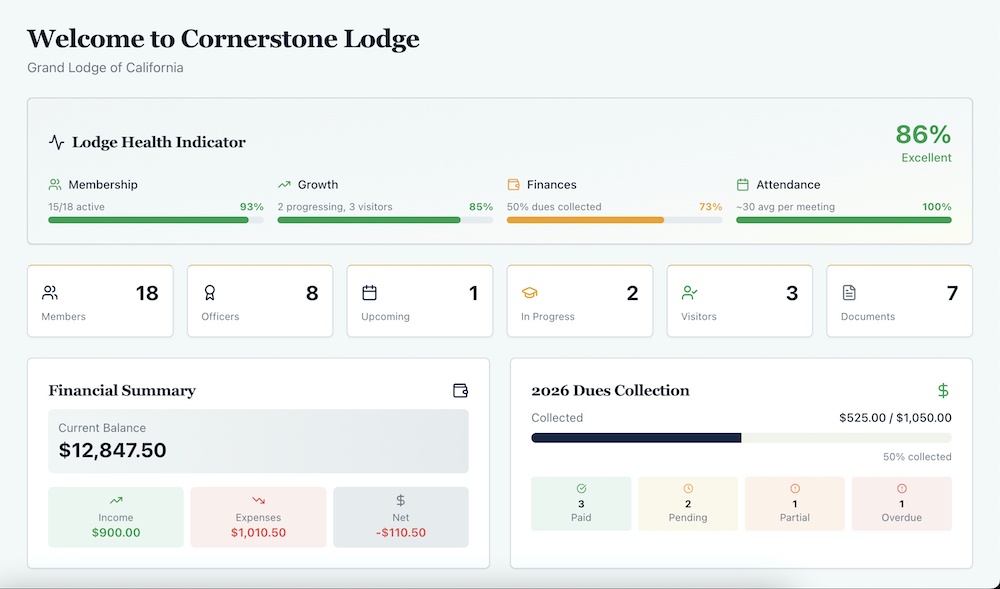
Need help managing your Lodge? See the new Masonic Lodge Secretary tool we have for you.
Volunteer for Something
The fastest way to get more invested in lodge is to actually do something.
Volunteer for a committee. Help out with an event. Offer to do a short presentation on something you’ve been studying. Step up when they need someone to help with degree work.
When you have a role, even a small one, your relationship to lodge changes. You’re not just attending. You’re contributing. You’re part of making it work.
And here’s the secret: the guys who volunteer are the ones who stick around. They’re the ones who develop real connections. They’re the ones who find lodge meaningful instead of obligatory.
It doesn’t have to be a huge commitment. Start small. Bring coffee one month. Help set up chairs. Whatever.
Just do something beyond showing up and sitting there.
Bring Questions
One of my biggest mistakes early on was thinking I shouldn’t ask questions. Like I was supposed to just absorb everything through osmosis and figure it out on my own.
That’s nonsense.
Come to lodge with questions. Things you’ve been reading about and want to understand better. Symbols you’ve noticed but don’t know the meaning of. Practices in your jurisdiction that seem different from what you’ve read online.
The Brothers who’ve been around for decades love talking about this stuff. But they’re not going to just randomly start lecturing you. You have to ask.
And asking questions serves another purpose: it shows other Brothers what you’re interested in. They’ll start bringing you books to borrow. Recommending lectures to watch. Connecting you with other Brothers who share your interests.
Lodge becomes a lot more valuable when people know what you’re looking for.
If you’re studying through something structured, like the courses available at MasonicFind, bring what you’re learning to lodge. “Hey, I was going through this lesson on the Fellowcraft degree and it mentioned something I’ve never heard before. Anyone know about this?”
Those conversations can take the learning from theoretical to practical. From something you read to something you actually understand.
Make It a Sacred Hour
Here’s something a Past Master told me that changed my perspective: “Treat the time in lodge as sacred, even when the content isn’t.”
What he meant was this: for that one hour, or two hours, or however long you’re there, make it time that’s set apart. Not just physically, but mentally.
Leave work at the door. Leave the argument you had with your spouse. Leave the stress about money or health or whatever else is weighing on you.
Be fully present. Not because the business meeting deserves it, but because you deserve it. Because the Brothers sitting next to you deserve it. Because the lodge itself, as an institution, deserves it.
We’re all so fragmented, so divided across a thousand competing demands. Lodge can be the one place where you’re just there. Fully. Completely.
That’s rare in 2026. That’s valuable.
And when you approach it that way, even the boring parts become meaningful. Because it’s not about the treasurer’s report. It’s about being in a room with your Brothers, sharing space and time, being part of something that’s been happening in unbroken succession for 300 years.
Connect Beyond Lodge Night
The guys I’m closest to in lodge? We don’t just see each other on meeting nights.
We text between meetings. Grab lunch occasionally. Help each other with projects. Meet up for a degree at another lodge.
Lodge night is important, but it’s not sufficient. If you only connect with your Brothers once or twice a month for a couple hours, you’re not building real relationships.
Find ways to stay connected. Join the group chat if your lodge has one. Participate in the Freemasons’ Community or similar online spaces where you can discuss Masonic topics with Brothers between meetings. Organize informal meetups.
When you have that continuous connection, lodge night becomes more meaningful. You’re not starting from scratch every time. You’re continuing conversations. Building on relationships.
And honestly, knowing that I can text a Brother any day of the week makes the time I spend in lodge richer. These aren’t just guys I see once a month. They’re actual friends.
Lower Your Expectations (In a Good Way)
Stop expecting every lodge night to be transformative.
Some nights are going to be boring. Some meetings will feel like a waste of time. Some evenings, you’ll drive home thinking “I could have just stayed home.”
That’s fine. That’s normal.
Not every practice is a peak experience. Not every workout is your best workout. Not every lodge night is going to be the night where everything clicks.
But if you keep showing up, if you approach it with intention, if you invest in the margins, the cumulative effect is huge.
Three years ago, lodge was just something I did because I was supposed to. Now? It’s one of the most important parts of my life. Not because every meeting is amazing, but because the sustained practice of showing up and engaging has built something real.
The Brothers I know there are genuine friends. The principles I’ve learned have changed how I live.
The sense of belonging to something larger than myself gives me grounding in a chaotic world.
But none of that came from one perfect lodge night. It came from a hundred imperfect ones where I chose to be present and engaged anyway.
The Practical Takeaway

You’re busy. I get it. Time is limited. Every commitment has to justify itself.
Lodge night can absolutely be worth the time. But you have to treat it like it matters.
Show up early. Stay late. Talk to different people. Pay attention to the ritual. Volunteer for something. Bring questions. Make the time sacred.
And between meetings, stay engaged. Take courses that deepen your understanding. Join communities where you can connect with Brothers beyond your local lodge. Build your knowledge so that when you show up, you have more to contribute.
The nine courses available inside the Freemasons’ Community, for instance, provide structured content to work through between meetings. Then when you’re at lodge, you can bring what you’re learning into conversations.
You can ask better questions. You can contribute more meaningfully.
The Brothers who get the most out of lodge aren’t the ones who just show up. They’re the ones who show up prepared, engaged, and intentional.
Your lodge needs it. The Craft needs it. And honestly, you need it too.
See you at lodge.
TrestleLog: Finally, a proper way to log your Masonic journey. Track every meeting, degree and milestone in one place.
Great Masonic Library: Unlock 300+ rare and out-of-print Masonic books that most Masons will never get to read.
MasonicMentor.AI: Get instant answers to your Masonic questions, any time. Like having a wise mentor available 24/7.
Masonic Courses: Go deeper than your Lodge can take you. In-depth courses on history, ritual and philosophy at your own pace.
FreemasonryAI: Save hours every month with 150+ AI prompts built specifically for Lodge officers and Masonic education nights.
Masonic Etiquette: Know exactly how to conduct yourself in Lodge. The guide every Mason wishes they had from day one.
Masonic Lessons: The lessons behind the ritual, explained clearly. Deepen your understanding at every degree.
Lodgeman Bundle: Everything a dedicated Mason needs in one bundle. The best value way to invest in your Masonic education.
Masonic Lectures: Classic lectures that have shaped Freemasonry for generations, ready for you to study and deliver.
The Masonic Way: Freemasonry is more than a meeting. Discover how to live its principles every single day.
100 Facts About Freemasonry: Surprising, fascinating and little-known facts about the Craft. Perfect for Masons and curious minds alike.
Become a Freemason: Thinking about joining? This guide walks you through everything you need to know before you knock on the door.