I remember standing outside the lodge room after my Third Degree, still buzzing from the experience, when a now-fellow MM pulled me aside. “Brother,” he said;
“You’ve just been raised to the sublime degree of Master Mason. Now the real work begins.”
He was right, though I didn’t fully understand what he meant at the time.
If you’re reading this, you’re probably in a similar position, newly raised, or maybe you’ve been a Master Mason for a while but feel like you’re missing something.
The degrees were powerful, the ritual was beautiful, but now what? How do you actually start learning what all of this means?
Let me share what I wish someone had told me when I started.
Freemasons Community: Join thousands of Masons from around the world in a private, active community built for the Craft.
Masonic Lodge Secretary: Stop drowning in paperwork. Manage your entire Lodge from one simple, purpose-built tool.
MasonicFind Newsletter: The weekly read for serious Masons. Insights, ideas and resources delivered straight to your inbox.
The Problem Nobody Talks About
Here’s the uncomfortable truth: most lodges aren’t set up for Masonic education. We’re great at conferring degrees and running business meetings.
We excel at pancake breakfasts and charity work. But sitting down and actually teaching Brothers the deeper meaning behind what we do?
That often falls through the cracks.
It’s not anyone’s fault. The officers are busy learning their ritual. The Past Masters have other commitments. Everyone assumes someone else is handling the education piece.
Meanwhile, you’re left trying to figure out why the Fellowcraft degree spent so much time talking about the liberal arts, or what the actual point of that whole Hiramic legend was.
You can read Morals and Dogma or Mackey’s Encyclopedia, but let’s be honest, jumping straight into those feels like trying to learn quantum physics when you barely passed high school chemistry.
Start Where You Actually Are
The first step is admitting what you don’t know. And Brother, none of us knew much when we started.
You need to get grounded in the basics before anything else makes sense.
What’s the actual history of Freemasonry?
Not the conspiracy theory stuff, and not the “we built Solomon’s Temple” mythology; the real, documented history.
How did we go from actual stonemasons to a philosophical fraternity?
Why do different Grand Lodges do things differently?
What’s the deal with Prince Hall recognition?
These aren’t sexy topics, but they’re foundational questions.
You can’t understand the symbolism without understanding the context.
I spent my first year reading everything I could find online, which was a mistake.
Half of it was nonsense written by people who’d never set foot in a lodge. The other half contradicted itself. What I needed was a structured approach, something that built knowledge in a logical sequence.
If you’re looking for that kind of structured foundation, there are resources designed specifically for this.
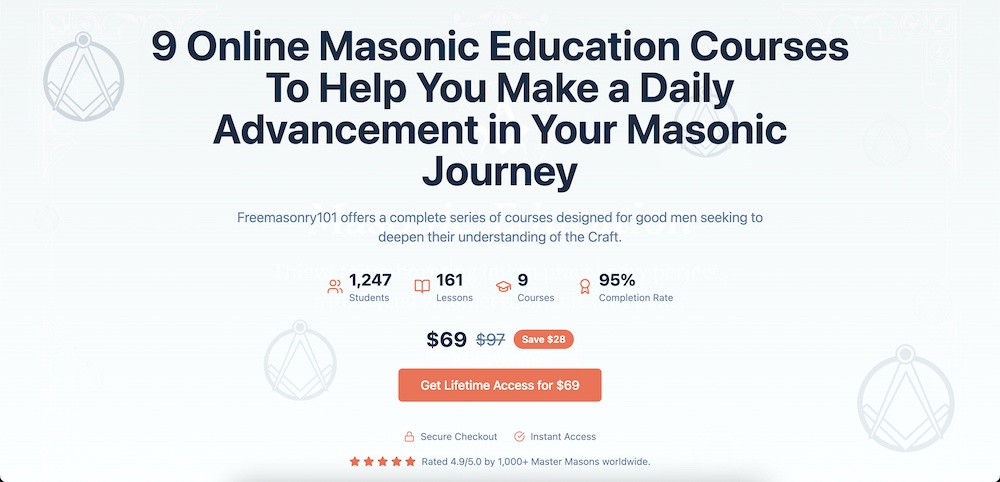
The online courses at MasonicFind walk through the three degrees systematically, along with Masonic philosophy, in a way that actually makes sense.
Nine courses total, and you can work through them at your own pace.
It’s not the only option out there, but it’s one of the better ones I’ve seen for Brothers who want to learn without spending years figuring out which books to read in which order.
The Ritual Matters More Than You Think
Look, I get it. Memorizing ritual can feel like homework. And depending on your jurisdiction, you might be required to prove proficiency before you can advance or take an officer position.
But here’s what changed my perspective: ritual isn’t just about memorizing words. It’s an initiation technology that’s been refined over centuries. Every word is there for a reason. When you actually understand what you’re saying (when you connect the words to their meaning) something clicks.
The ritual is the skeleton key to understanding everything else in Freemasonry. The lectures explain the symbolism. The charges tell you how to live as a Mason.
The obligations define what we’re actually promising each other.
Don’t just memorize. Study.
Ask your mentor or coach why specific phrases are used. Look up the historical context. Connect it to what you learned in your degrees.
And yes, it’s easier when you have someone breaking it down for you rather than just staring at a cipher book wondering what any of it means.
Dig Into What the Degrees Actually Mean
The three degrees of Blue Lodge are brilliant, but they’re also dense. You can’t possibly catch everything on the first pass, or the tenth, honestly.
Each degree is doing multiple things at once.
The Entered Apprentice is teaching you about preparation, humility, and seeking light. But it’s also introducing you to the working tools, establishing your relationship to the lodge, and beginning your journey through specific symbols that will recur throughout your Masonic life.
The Fellowcraft gets overlooked sometimes because it’s sandwiched between the dramatic first degree and the powerful third. But it’s arguably the most intellectually rich of the three. The focus on the liberal arts and sciences, the middle chamber lecture, the winding stairs, there’s so much there about how we understand our place in the universe.
And the Master Mason degree… well, you know. The Hiramic legend alone could be studied for years. Mortality, integrity, resurrection, the limits of human knowledge, it’s all packed in there.
Take your time with each one. Read different interpretations. Compare notes with other Brothers. You’ll find that Masons have been arguing about what these degrees mean for 300 years, and that’s kind of the point.
The meaning isn’t handed to you, you have to work for it.
Find Your People
One of the best parts of going deep into Masonic education is discovering that you’re not alone. There are Brothers all over the world who are just as fascinated by this stuff as you are.
Your lodge might have a few of them. Maybe there’s a study group or education committee. If you’re lucky, there’s a Brother who lights up when you ask him about symbolism and will talk your ear off for hours.
But honestly? Most lodges don’t have a critical mass of Brothers interested in the educational side.
It’s not that they don’t care, they just have different interests.
Some guys are all about the charity work. Others love the social aspect.
Some just want to support the fraternity their grandfather belonged to. All of that is valid.
But if you’re the kind of person who wants to understand the esoteric meanings, you need to find other Brothers who share that passion.
The conversations you’ll have with them—comparing practices from different jurisdictions, debating interpretations of symbols, sharing book recommendations – that’s where a lot of the real learning happens.
These days, you don’t have to be limited to your local area.
There are online communities where thousands of Masons gather to discuss exactly this stuff.
The Freemasons’ Community, for instance, has over 1,100 Master Masons from around the world.
It’s useful because you can post a question at midnight and wake up to thoughtful responses from Brothers in different time zones, different Grand Lodges, and different perspectives.
It’s not a replacement for your lodge, but it’s a supplement. And sometimes, it’s nice to be able to ask a question without worrying about lodge politics or seeming like you’re challenging anyone.
Build Your Library (Without Going Broke)
At some point, you’re going to want books. Lots of books.
The good news is that many classic Masonic texts are now in the public domain. The bad news is that finding them, figuring out which ones are worth reading, and wading through 19th-century prose can be a challenge.
You don’t need to drop thousands of dollars buying rare first editions (unless that’s your thing, no judgment). But you do need access to the foundational texts. Mackey, Pike, Oliver, Fort Newton, Wilmshurst, these guys shaped how modern Masons understand the Craft.
The issue is knowing where to start and what order to read them in. Just diving into Albert Pike without context is a recipe for confusion and frustration.
Some Brothers have built digital libraries with the key texts organized and searchable. The Great Masonic Library that comes with The Freemasons’ Community membership, for example, has over 1,000 books from the mid-1800s onward.
Saves you from hunting down low-quality PDFs or buying books you’ll only reference once.
However you do it, start building that library. Reference it when questions come up. Cross-reference different authors. See how interpretations have changed over time.
Learn How You Learn
Not everyone learns the same way. Some Brothers can plow through dense texts and retain everything. Others need to hear it explained out loud. Some need visual diagrams. Some need to discuss it.
Figure out what works for you, then lean into it.
If you’re an auditory learner, find Masonic podcasts or recorded lectures. If you need to see it, look for documentaries or illustrated books. If you learn through discussion, join study groups or online forums.
The point is to actually learn this stuff, not to torture yourself with methods that don’t work for your brain.
Personally, I’ve found that a mix works best. Read something, listen to someone else’s take on it, then discuss it with other Brothers. The repetition from different angles helps it stick.
Get a Mentor (Or Be One)
The mentor-mentee relationship is supposed to be central to Freemasonry, but in practice, it’s hit or miss.
If your lodge has a formal mentorship program, great. Use it. If your mentor is engaged and knowledgeable, you’re lucky. Pick his brain. Ask the dumb questions. Let him know what you’re interested in learning.
If your lodge doesn’t have this, or if your assigned mentor is too busy to be helpful, find someone else. Look for a Past Master who seems to actually understand the philosophy behind what we do.
Most of them are happy to help if you show genuine interest.
And here’s the thing: even if you’re new, you can mentor someone newer. Explaining what you’ve learned to someone else is one of the best ways to solidify your own understanding.
Actually Live This Stuff
The real test isn’t how many books you’ve read or how much ritual you’ve memorized. It’s whether you’re actually becoming a better man.
Freemasonry teaches you to be charitable, honest, self-disciplined, and dedicated to truth. Those aren’t just nice ideas to contemplate; they’re supposed to change how you live.
- Are you more patient with people than you were last year?
- Do you control your temper better?
- Are you more honest in your business dealings?
- Do you give more generously?
- Are you working on subduing your passions and improving yourself in Masonry?
If the answer is no, then all the education in the world is just intellectual masturbation. The point is to take these principles and apply them.
Check in with yourself regularly. The phrase “making a daily advancement in Masonic knowledge” isn’t just about learning facts, it’s about becoming the kind of person the ritual describes.
Just Start
You don’t need to have everything figured out before you begin. You don’t need the perfect plan or all the resources assembled. You just need to start.
Pick one thing. Read one book. Take one course. Join one discussion. Ask one question.
The Brothers who know the most aren’t the ones who had some special advantage. They’re the ones who stuck with it, year after year, degree by degree, book by book, conversation by conversation.
There’s no finish line here. I’ve met 50-year Masons who are still discovering new layers of meaning in the degrees they’ve seen hundreds of times. That’s the beauty of it, there’s always more to learn.
If you want a structured starting point, the eight courses we have cover the core material systematically.
If you want to connect with Brothers worldwide who are on the same journey, the Freemasons’ Community gives you that space. If you want access to a library of classic texts without hunting them down one by one, that’s available too.
But those are just tools. What matters is your commitment to actually doing the work.
The ancient mysteries aren’t going to reveal themselves while you’re scrolling social media or binging Netflix. You have to pursue them. You have to study. You have to reflect. You have to apply what you learn.
That Past Master was right. The real work begins after you’re raised. The question is whether you’re going to do it.
The tools are there. The resources exist. The community is waiting.
Now it’s on you, Brother.
TrestleLog: Finally, a proper way to log your Masonic journey. Track every meeting, degree and milestone in one place.
Great Masonic Library: Unlock 300+ rare and out-of-print Masonic books that most Masons will never get to read.
MasonicMentor.AI: Get instant answers to your Masonic questions, any time. Like having a wise mentor available 24/7.
Masonic Courses: Go deeper than your Lodge can take you. In-depth courses on history, ritual and philosophy at your own pace.
FreemasonryAI: Save hours every month with 150+ AI prompts built specifically for Lodge officers and Masonic education nights.
Masonic Etiquette: Know exactly how to conduct yourself in Lodge. The guide every Mason wishes they had from day one.
Masonic Lessons: The lessons behind the ritual, explained clearly. Deepen your understanding at every degree.
Lodgeman Bundle: Everything a dedicated Mason needs in one bundle. The best value way to invest in your Masonic education.
Masonic Lectures: Classic lectures that have shaped Freemasonry for generations, ready for you to study and deliver.
The Masonic Way: Freemasonry is more than a meeting. Discover how to live its principles every single day.
100 Facts About Freemasonry: Surprising, fascinating and little-known facts about the Craft. Perfect for Masons and curious minds alike.
Become a Freemason: Thinking about joining? This guide walks you through everything you need to know before you knock on the door.