We lost three candidates last year. Not to scheduling conflicts or family obligations.
We just lost track of them.
One got initiated in March. His mentor moved out of state in April. Nobody assigned a new one.
By June, he’d stopped showing up. Nobody noticed until September. By then, he was gone.
That’s a $600 hit in lifetime dues, assuming he would have stayed active for twenty years. But the real cost wasn’t money.
It was what he could have become. Maybe a future Worshipful Master. Maybe the guy who’d mentor ten other candidates. Maybe just a good Brother who’d show up consistently.
We’ll never know. Because our administration failed him before the Craft ever got the chance.
Freemasons Community: Join thousands of Masons from around the world in a private, active community built for the Craft.
Masonic Lodge Secretary: Stop drowning in paperwork. Manage your entire Lodge from one simple, purpose-built tool.
MasonicFind Newsletter: The weekly read for serious Masons. Insights, ideas and resources delivered straight to your inbox.
The Bill Nobody Sees
Most lodges talk about costs in dollar terms. Grand Lodge fees. Building maintenance. Apron replacement.
Those show up on the balance sheet. They get discussed in stated meetings. They’re visible.
The costs I’m talking about don’t appear anywhere. They’re not line items. They’re not budget categories.
But they’re killing lodges anyway.
Lost candidates who never make it to Master Mason. Members who drift away because nobody tracks engagement. Officers who burn out after one term. Knowledge that walks out the door with every transition.
Milestones nobody celebrates because nobody’s tracking them. Visitors who come once and never return because nobody follows up. Education that doesn’t happen because planning takes too long.
You can’t put a dollar amount on most of this. But it adds up to lodges that shrink, stagnate, and eventually struggle to survive.
When Candidates Fall Through the Cracks
Here’s how it usually happens.
Guy gets initiated. He’s excited. Shows up to his first few meetings. Gets assigned a mentor who’s busy with work and family.
The mentor means well. But weeks pass. Nobody checks in. The candidate doesn’t want to be pushy.
Three months go by. Four. Six.
The candidate stops coming. He’s embarrassed. He doesn’t know his proficiency. He feels like he’s failed. Nobody reaches out because nobody’s tracking when he was supposed to progress.
Eventually, someone asks “Whatever happened to that EA from spring?”
Nobody knows. He’s just gone.
This happens in lodges everywhere. Not because anyone’s malicious. Because there’s no system to catch it.
How many Master Masons did your lodge never create? How many Brothers did you lose before they ever became Brothers?
That’s not a financial cost. That’s an existential one. Every lost candidate is a future leader you’ll never have.
The Officer Burnout Cycle
Your Secretary serves for three years. He’s good at it. Keeps everything organized. Answers every question. Never misses a deadline.
Then he steps down. Because he’s exhausted.
The new guy steps in. Spends six months just figuring out where everything is. Rebuilding systems the previous Secretary had in his head.
By the time he’s competent, he’s already tired. Serves one term. Steps down.
Next guy. Same cycle.
This happens because administration in most lodges is personal, not institutional. The Secretary doesn’t manage a system. He is the system.
When he leaves, the system leaves with him.
The cost? Officers who serve shorter terms. Less institutional memory. More time spent rebuilding what was already built. Fewer Brothers willing to serve because they see how hard it is.
Eventually you’re stuck asking the same few guys over and over because nobody else wants the job.
Knowledge That Disappears
Your lodge approved a major bylaw change in 2019. Why did you do it? What problem were you solving?
If you’re lucky, someone remembers. More likely, you have to dig through old minutes hoping the reasoning was recorded.
Your Treasurer set up a new budget category three years ago. What’s it for? Who decided this?
A candidate from 2020 never finished his degrees. Why? Was there a problem? Did he move? Did someone fail him?
Nobody knows. He’s just listed as “inactive EA” in a spreadsheet somewhere.
This is the knowledge cost. Every time an officer changes, information disappears. Not because anyone’s careless, but because most lodges don’t preserve context.
You keep the facts. Meeting happened. Motion passed. Bill paid.
But the why? The background? The reasoning? That leaves with the officer who made the decision.
Ten years later, you’re making the same mistakes because nobody remembers why you stopped doing something the first time.
Milestones Nobody Celebrates
Brother Johnson has been a Mason for 50 years. Initiated April 1975.
Does your lodge know this? Did you recognize it? Did you do anything special?
Or did April come and go without anyone noticing?
Most lodges track milestones poorly or not at all. Birthdays. Masonic anniversaries. Years of service.
The Secretary might remember to check. Might not. Might look it up for the big ones but miss the smaller ones.
Meanwhile, Brother Johnson sits at home wondering if anyone noticed. If anyone cares. If he still matters to the lodge he’s been supporting for half a century.
The cost? Disengagement. Members who quietly drift away because they feel invisible. Brothers who stop coming because nobody seems to notice when they do.
It’s not intentional. Nobody’s trying to ignore people. But without systems to track this stuff, it just doesn’t happen.
The Financial Blindness Problem
Your lodge has money in the bank. How long will it last?
Not what’s the balance right now. How long until you run out at your current burn rate?
Most Treasurers don’t know. The balance is positive, so everything’s fine. Until suddenly it’s not.
You’re collecting $8,000 in dues annually. You’re spending $10,000 on operations. You’re running a $2,000 deficit.
When does that become a crisis? When the balance hits zero? When you can’t pay Grand Lodge fees? When you have to ask for emergency assessments?
Or earlier, when you could actually do something about it?
The cost of financial blindness is reacting too late. Cutting essential spending. Raising dues suddenly. Creating emergencies that could have been avoided.
You’re not missing financial data. You have it. You’re just not looking forward with it.
When Members Become Numbers
Your lodge has 85 members on the books. How many are actually active?
Most lodges don’t know. They know who shows up regularly. But active membership versus total membership? That requires counting.
And if you don’t know your active member count, you don’t know your lodge’s health. You’re looking at a gross number that includes guys who haven’t shown up in fifteen years.
Sixty members sounds healthy. Sixty members with twelve active is dying.
The cost? Making decisions based on false confidence. Thinking you’re fine because the member count looks good. Missing the slow decline until it’s too late to stop.
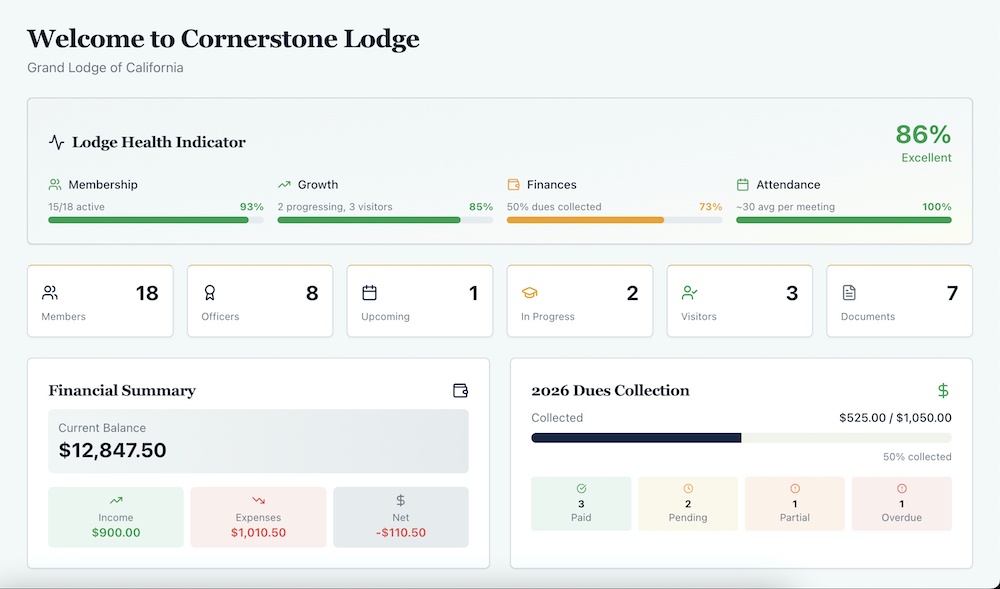
We realized this when we started using Masonic Lodge Secretary. The Lodge Health Indicator showed us our active member ratio. It wasn’t what we thought.
On paper, we looked healthy. In reality, we were in trouble. But seeing the real numbers meant we could actually address it.
Meetings That Waste Time
Your stated meeting runs two hours. How much of that is actually meaningful?
Opening and closing ritual, sure. Degree work when it happens. Maybe some good discussion.
But how much time is spent on “Does anyone know if Brother Smith paid his dues?” and “When’s the next meeting?” and “Who was that visitor we had last month?”
Questions that should take five seconds but take five minutes because nobody can find the information quickly.
The cost? Long, tedious business meetings that make Brothers dread coming. Time wasted on administrative questions instead of education or fellowship.
Officers scrambling to answer questions they should be able to answer instantly.
Eventually, attendance drops because meetings are boring. And they’re boring partly because administration is slow.
The Engagement Death Spiral
Here’s how lodges die slowly.
Members stop coming because meetings are tedious. Attendance drops because there’s no follow-up with people who miss. Candidates get lost because nobody’s tracking progress.
Officers burn out because everything’s manual. Nobody wants to serve because it looks miserable. Knowledge disappears with every transition.
The active member count shrinks. Fewer guys doing more work. More stress. More burnout. More people checking out.
Eventually you’re down to a core of eight guys keeping the lodge alive. And they’re exhausted.
This isn’t dramatic. There’s no single crisis. Just a slow erosion of engagement, energy, and hope.
The cost? Your lodge becoming a burden instead of a blessing. Officers who see their position as a sentence to serve, not an honor.
Members who pay dues but don’t show up because there’s nothing drawing them back.
What Prevention Actually Costs
Here’s the thing about all these costs: they’re preventable. Not completely. You’ll still lose some candidates. Some members will still disengage.
But most of it? That’s systems failing, not people.
Preventing these costs doesn’t require heroic effort. It requires decent administration. Information that’s accessible. Records that persist. Systems that survive transitions.
It requires treating lodge management like it matters. Not as an afterthought, but as a foundation.
The lodges that avoid these hidden costs aren’t lucky. They’re organized. They track what matters. They maintain continuity. They make administration easy enough that it actually gets done.
For us, that meant moving everything into one place where it couldn’t get lost. Member records, meeting history, financial tracking, degree progress all in Masonic Lodge Secretary.
Not because it’s magical. Because it meant we stopped losing information every time an officer changed.
The return on that? Candidates who make it to Master Mason. Members who feel noticed and valued. Officers who serve multiple terms because the job isn’t crushing them.
That’s not a dollar figure. But it’s worth more than anything on your balance sheet.
The Real Question
Your lodge is paying these hidden costs right now. You just don’t see them on a financial report.
Lost potential in candidates who slip away. Exhausted officers who won’t serve again. Members who drift off because nobody notices when they’re gone.
Knowledge that vanishes with every transition. Milestones that pass uncelebrated. Meetings that waste time on questions that should be instant.
Add it up. Not in dollars, but in what your lodge could be versus what it is.
- How many more Master Masons would you have if you didn’t lose candidates?
- How much stronger would your officer corps be if people wanted to serve?
- How much more engaged would your members be if you could actually track and respond to their participation?
The question isn’t whether you can afford better administration. It’s whether you can afford not to.
Because the bill is coming due. Maybe not this year. Maybe not next year. But eventually.
And by then, it might be too late to do anything about it.
TrestleLog: Finally, a proper way to log your Masonic journey. Track every meeting, degree and milestone in one place.
Great Masonic Library: Unlock 300+ rare and out-of-print Masonic books that most Masons will never get to read.
MasonicMentor.AI: Get instant answers to your Masonic questions, any time. Like having a wise mentor available 24/7.
Masonic Courses: Go deeper than your Lodge can take you. In-depth courses on history, ritual and philosophy at your own pace.
FreemasonryAI: Save hours every month with 150+ AI prompts built specifically for Lodge officers and Masonic education nights.
Masonic Etiquette: Know exactly how to conduct yourself in Lodge. The guide every Mason wishes they had from day one.
Masonic Lessons: The lessons behind the ritual, explained clearly. Deepen your understanding at every degree.
Lodgeman Bundle: Everything a dedicated Mason needs in one bundle. The best value way to invest in your Masonic education.
Masonic Lectures: Classic lectures that have shaped Freemasonry for generations, ready for you to study and deliver.
The Masonic Way: Freemasonry is more than a meeting. Discover how to live its principles every single day.
100 Facts About Freemasonry: Surprising, fascinating and little-known facts about the Craft. Perfect for Masons and curious minds alike.
Become a Freemason: Thinking about joining? This guide walks you through everything you need to know before you knock on the door.