We had 28 members at our January stated meeting. By June, we were down to 19.
The Worshipful Master asked what happened. Nobody had a good answer.
“Guys are busy.” “Summer’s always slow.” “That’s just how it is.”
But we didn’t actually know. We were guessing. We had no data, just impressions and excuses.
Then someone suggested we look at who stopped coming. Not “attendance is down” in the abstract, but which specific Brothers stopped showing up and when.
Turns out it wasn’t random. And it wasn’t summer. We had patterns we’d never noticed because we weren’t looking.
Freemasons Community: Join thousands of Masons from around the world in a private, active community built for the Craft.
Masonic Lodge Secretary: Stop drowning in paperwork. Manage your entire Lodge from one simple, purpose-built tool.
MasonicFind Newsletter: The weekly read for serious Masons. Insights, ideas and resources delivered straight to your inbox.
The Numbers Most Lodges Don’t Track
Most lodges know how many people came to the last meeting. Maybe the last few meetings if the Secretary’s diligent.
But here’s what they don’t know:
Which members came to the last six meetings versus which came to none? Who used to attend regularly but stopped? When did they stop? Who’s been absent for three months? For six months? For a year?
You can’t answer these questions without data. And most lodges don’t have data. They have impressions.
“Attendance is good.” “Attendance is down.” “Brother Smith hasn’t been around lately.”
All vague. All useless for actually understanding what’s happening.
When we started tracking attendance in Masonic Lodge Secretary, we could finally see the patterns. Brother A came to every meeting in Q1, then disappeared in Q2. Brother B came once, never returned. Brother C has attended exactly one meeting per quarter for two years.
These aren’t random. They’re signals. But you can’t see signals without data.
The Three-Meeting Rule
Here’s what we found: most Brothers who stop coming do it gradually. They don’t quit. They just fade.
They come every month. Then every other month. Then quarterly. Then not at all.
The warning sign? Missing three consecutive meetings.
Once a Brother misses three in a row, he’s unlikely to come back without intervention. It’s not impossible, but the odds drop significantly.
Most lodges don’t notice until six months later. By then, the Brother’s gone. He’s not coming back. He’s already mentally checked out.
But if you catch it at three meetings? You can still reach out. “Hey Brother, haven’t seen you. Everything okay?”
Sometimes life got in the way and he just needs a reminder that he’s missed. Sometimes there’s an issue with the lodge he’s hesitant to raise. Sometimes he just needed someone to notice he was gone.
You can’t do this without tracking who’s coming and who isn’t. “I think Brother Johnson hasn’t been around” isn’t actionable. “Brother Johnson missed October, November, and December” is.
New Members Who Disappear
We raised five Brothers last year. Two of them stopped coming within four months.
Why? Nobody asked them. Nobody noticed when they stopped showing up. Nobody followed up.
New Master Masons are especially vulnerable. They just went through months or years of degree work. Suddenly the structure disappears. No more proficiency. No more mentor check-ins. No more “you need to be here for your degree.”
They show up to their first stated meeting as a Master Mason. It’s two hours of reading bills and approving minutes. Nobody talks to them after. They go home wondering what they just joined.
They come back once more. Maybe twice. Then they stop.
And the lodge doesn’t notice because new members are expected to figure it out. “He knows when we meet. He’ll come if he wants to.”
That’s not how retention works. New members need engagement. They need to feel noticed. They need reasons to come back beyond just “it’s Tuesday.”
We started tracking new member attendance specifically. First six months after raising. If they miss two meetings in that window, someone reaches out.
Retention went up. Not because we changed what we do at meetings. Because we stopped losing guys to neglect.
The Core Group Problem
Most lodges have a core group. Same ten to fifteen guys at every meeting. Reliable. Committed. The lodge runs on them.
Everyone else is peripheral. They come sometimes. Maybe quarterly. Maybe less.
The lodge assumes this is fine. “We’ve got our core group. Everyone else shows up when they can.”
But here’s the problem: the core group ages. They retire. They move. They die.
And you’re not building the next core group because you’re not engaging the peripheral members.
Look at your last twelve meetings. How many different members attended? Fifty? Sixty?
Now how many came to at least half? Twenty? Fifteen?
That gap is your problem. You have a large membership on paper. A small membership in practice.
And the peripheral members are slowly drifting further out because nobody’s pulling them back in.
When Business Meetings Kill Attendance
Here’s the pattern we found: attendance dropped after boring meetings.
Not immediately. The next meeting would be fine. But two meetings later, you’d see a dip.
Brothers who came to a tedious two-hour business meeting would skip the next few. Not consciously. They just wouldn’t prioritize it.
When we tracked meeting attendance against meeting content, it was obvious. Degree nights had higher next-meeting attendance. Education nights had good retention. Business-only nights killed it.
Most lodges don’t see this because they’re not comparing meeting types to subsequent attendance. They just know “attendance varies” without understanding why.
You want better attendance? Track what happens after different types of meetings. You’ll probably find your business meetings are attendance killers.
The solution isn’t to stop doing business. It’s to stop doing only business. Pair it with something meaningful. Education. Degree work. Guest speakers. Something that justifies the drive.
The Follow-Up Nobody Does
Brother misses a meeting. What happens next?
In most lodges? Nothing. Maybe someone mentions it. “Where’s Brother Taylor?”
Nobody knows. Nobody asks. He’ll show up eventually. Or he won’t.
Meanwhile, Brother Taylor is home thinking nobody noticed he was gone. Nobody cares if he comes. Why bother?
Three months later, he’s not coming back. Six months later, he’s effectively demitted. The lodge just hasn’t made it official yet.
This happens over and over. Not because lodges don’t care, but because there’s no system for caring.
Following up requires knowing who to follow up with. That requires tracking attendance. That requires looking at the data.
When you can see that Brother Taylor missed the last three meetings, you can do something about it. Call him. Text him. “Hey, we miss you at lodge. Everything okay?”
Sometimes that’s all it takes. Someone noticed. Someone cared enough to ask.
Seasonal Patterns That Aren’t Actually Seasonal
Every lodge says “Summer’s slow. We’ll pick back up in September.”
Then September comes and attendance is still down. “Well, everyone’s still on vacation. October will be better.”
October’s not better. November’s not better. Suddenly it’s January and you’re wondering why attendance never recovered.
Here’s what we found: attendance doesn’t drop seasonally. Specific members drop out during specific months and never come back.
Brother A stops coming in June. You assume summer break. September comes. He doesn’t return. You don’t notice because you’re not tracking individuals, just overall counts.
Brother B stops coming in October. You assume work got busy. January comes. He’s still gone.
By next summer, you’ve lost six guys and you think it’s seasonal. It’s not. It’s cumulative neglect disguised as seasonal variation.
Track individuals, not just totals. You’ll see it’s not seasons. It’s specific Brothers who need specific follow-up.
What Visibility Actually Changes
When we started using Masonic Lodge Secretary to track attendance properly, nothing else changed. We didn’t add programs. We didn’t change meeting content. We didn’t send newsletters.
We just started seeing who came and who didn’t.
That visibility changed everything. We could see Brother Martinez hadn’t come in four months. We called him.
Turns out he was dealing with a family medical issue. He wanted to come but couldn’t commit. We told him we understood and to come back when he could.
He returned two months later. Said it meant a lot that we checked in.
We could see new Master Masons dropping off. We assigned mentors to check on them. Retention improved.
We could see which meetings had better follow-up attendance. We adjusted programming accordingly.
None of this required more work. It required knowing what was actually happening instead of guessing.
The Dashboard You’re Not Looking At
Your lodge has an attendance problem. You might not think you do because meetings feel busy enough.
But answer these questions:
How many members attended in the last six months? How many came to more than half the meetings? How many came once or not at all? Which Brothers stopped coming and when?
If you can’t answer these in thirty seconds, you don’t have visibility. You have impressions.
Impressions are useless. “Attendance seems fine” doesn’t help when it’s not fine and you don’t realize it until half your members have checked out.
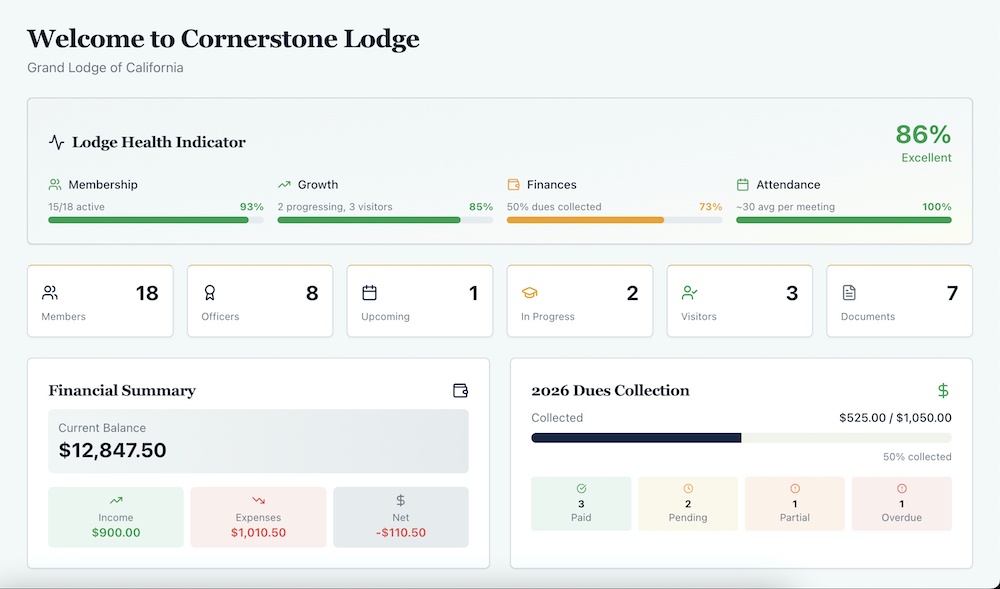
You need a dashboard. Not complicated metrics. Just clear data.
Total members. Active attenders. Declining attenders. At-risk Brothers who haven’t shown up in three meetings.
Look at it monthly. Act on what you see.
We put our attendance tracking in one place where officers could see trends over time. Not just “19 members came tonight” but how that compares to last month, three months ago, six months ago.
Is attendance improving or declining? Are the same people coming or are you getting different people? Are new members attending regularly or dropping off?
You can’t improve what you don’t measure. And most lodges aren’t measuring.
The Engagement Equation
Here’s what the data shows: attendance isn’t random. It’s a function of engagement.
Brothers who feel noticed come back. Brothers who feel invisible don’t.
Brothers who find value in meetings return. Brothers who sit through two hours of reading bills don’t.
Brothers who get personal follow-up when they’re absent come back. Brothers who disappear without anyone noticing stay gone.
This isn’t theoretical. It’s what happens when you actually track it.
The lodges with good attendance aren’t lucky. They’re not in better demographics. They don’t have younger members or better buildings.
They just notice who’s there and who isn’t. They follow up. They create reasons to return.
All of that requires visibility. You can’t engage someone you don’t know is disengaging.
Start With One Month
You don’t need to analyze five years of data. Start with one month.
Pull your attendance from the last stated meeting. Write down who came.
Now compare it to the previous meeting. Who came last time but not this time? Write those names down.
Those are your at-risk Brothers. Not the guys who never come. The guys who used to come but stopped.
Call them. Not to guilt them. To check in. “Haven’t seen you. Everything okay?”
Do this every month. Track who’s coming. Notice who stops. Follow up.
You’ll be amazed how many guys just needed someone to notice they were gone.
And you’ll be horrified at how many were slipping away while everyone assumed they were fine.
Attendance doesn’t fix itself. But it’s fixable. You just need to see what’s actually happening.
The data’s there. You just have to look at it.
TrestleLog: Finally, a proper way to log your Masonic journey. Track every meeting, degree and milestone in one place.
Great Masonic Library: Unlock 300+ rare and out-of-print Masonic books that most Masons will never get to read.
MasonicMentor.AI: Get instant answers to your Masonic questions, any time. Like having a wise mentor available 24/7.
Masonic Courses: Go deeper than your Lodge can take you. In-depth courses on history, ritual and philosophy at your own pace.
FreemasonryAI: Save hours every month with 150+ AI prompts built specifically for Lodge officers and Masonic education nights.
Masonic Etiquette: Know exactly how to conduct yourself in Lodge. The guide every Mason wishes they had from day one.
Masonic Lessons: The lessons behind the ritual, explained clearly. Deepen your understanding at every degree.
Lodgeman Bundle: Everything a dedicated Mason needs in one bundle. The best value way to invest in your Masonic education.
Masonic Lectures: Classic lectures that have shaped Freemasonry for generations, ready for you to study and deliver.
The Masonic Way: Freemasonry is more than a meeting. Discover how to live its principles every single day.
100 Facts About Freemasonry: Surprising, fascinating and little-known facts about the Craft. Perfect for Masons and curious minds alike.
Become a Freemason: Thinking about joining? This guide walks you through everything you need to know before you knock on the door.